2026-09-26
Drooping Eyelids: Non-Surgical Lifting vs. Surgery—Which Approach Do You Need?
Drooping eyelids stem from skin laxity, brow descent, or ptosis. Learn the differences between non-surgical lifting and surgical options to find your ideal treatment.

※ This article is provided for medical informational purposes only.
In accordance with Article 56, Paragraph 2 and Article 57 of the Medical Service Act,
this post is not subject to preliminary review, nor is it an advertising post unrelated to reviewed content.
Hello,
I am Dr. Jeong-Geun Park,
Director of FacePlus Plastic Surgery Clinic.

Your eyelids might feel heavier than before,
your double eyelid crease may be hidden,
or your overall eye expression may appear tired and dull.
When these changes begin to appear,
many suspect drooping eyelids (blepharoptosis/eyelid sagging)
and explore lifting procedures or surgery.
However, simply having sagging eyelids
does not mean everyone requires the exact same treatment.
Whether it is due to diminished skin elasticity,
a lowered eyebrow position,
or weakness in the eyelid-elevating muscles,
the ideal solution can vary significantly depending on the underlying cause.
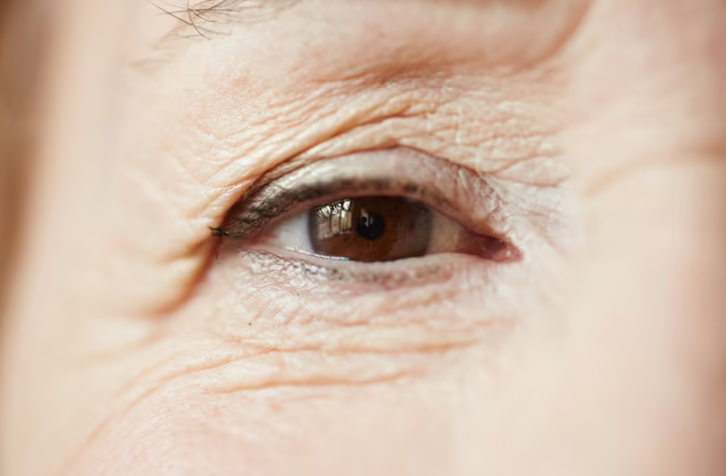
Today, we will take a closer look at the causes of drooping eyelids,
the difference between lifting and surgery,
and the surgical options available.
Table of Contents | ||
1. Why do eyelids droop? 2. Can non-surgical lifting improve it? 3. What surgical options are available? 4. How should you choose the right approach? |
1. Why do eyelids droop?
Drooping eyelids are often not merely
a matter of skin laxity
in a single isolated area.
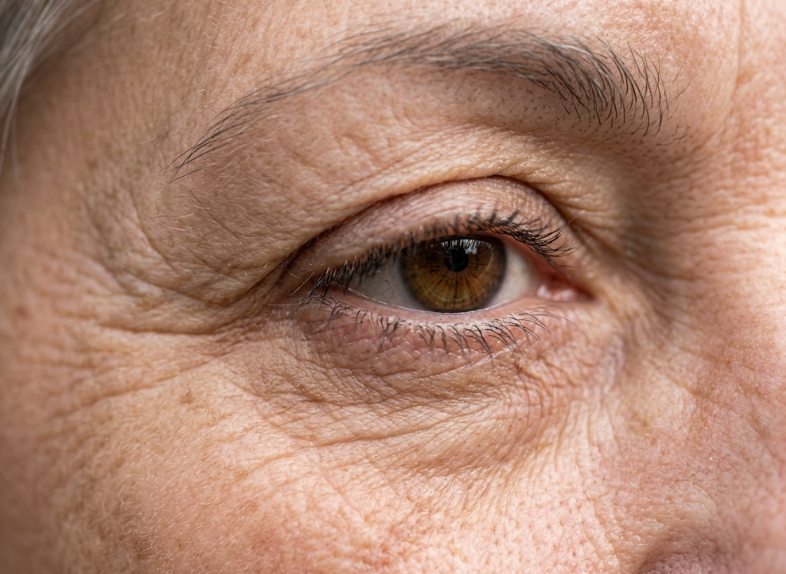
As we age, skin elasticity
gradually declines,
and the surrounding tissues around the eyes change as well.
During this process, the upper eyelid skin
sags downward,
which can make the eyes look heavy and tired.
In addition, when the eyebrows sag or lower,
the eyelid skin can fold over
and appear even more redundant.
A similar appearance can also occur
when the levator muscles that open the eyes are weak.
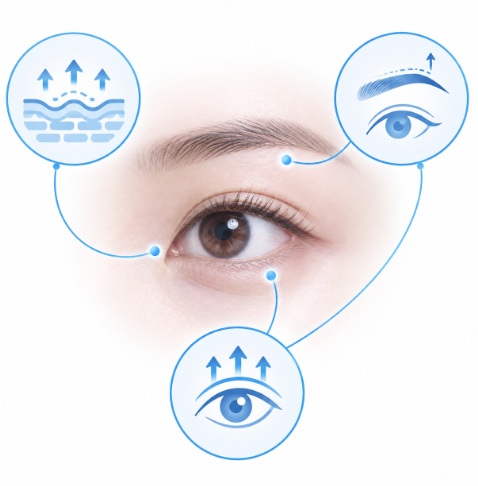
In such cases, people often develop a habit
of straining their forehead or repeatedly raising their eyebrows
to keep their eyes fully open.
Therefore, when addressing drooping eyelids,
one must evaluate not only the amount of sagging skin,
but also the position of the eyebrows and the muscle function.
2. Can non-surgical lifting improve it?
If the sagging is relatively mild
and primarily caused by reduced skin elasticity,
non-surgical lifting can be considered.
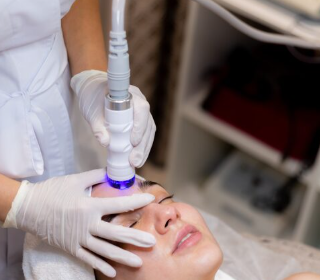
Lifting treatments utilizing
ultrasound or radiofrequency energy
aim to restore and enhance skin firmness.
They feature the major advantages of having no incisions
and allowing a relatively quick,
seamless return to daily life.
However, if there is a substantial amount of excess skin
or the eyebrows have significantly descended,
the outcomes of non-surgical lifting alone may be limited.
Particularly, if the primary cause of the drooping eyelid
is not simple skin laxity,
a different therapeutic approach will be necessary.
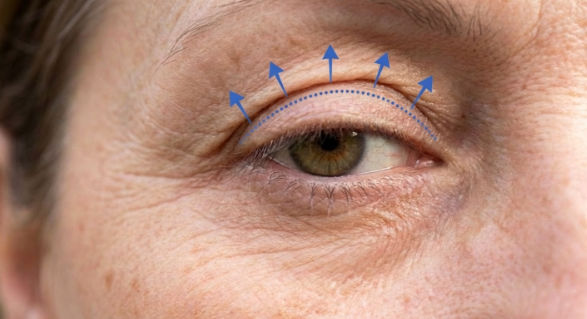
Therefore, before deciding on any procedure,
it is crucial to first determine
the precise location and severity of the sagging.
3. What surgical options are available?
When drooping eyelids are pronounced,
surgery can be considered
based on the underlying cause and periocular anatomical structure.
One representative method
is upper blepharoplasty.
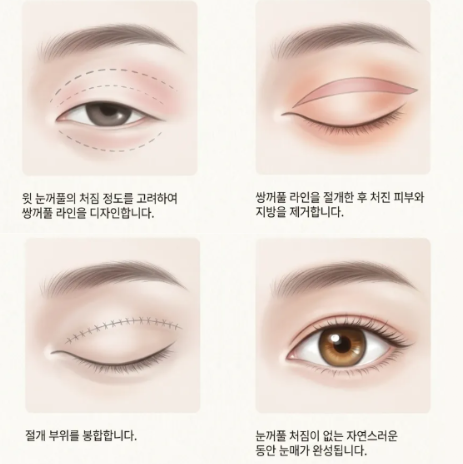
This procedure refines the eye contour
by excising and tightening the loose upper eyelid skin
within the required range.
Another common approach is the sub-brow lift (infrabrow excision).
In this technique, redundant skin is excised
along the lower border
of the eyebrow.
It is often considered
when a patient wishes to preserve
their existing double eyelid line as much as possible.
However, if eyelid drooping is primarily caused
by the descent of the eyebrow itself,
a completely different approach is warranted.
In such instances, upper tissues are repositioned
through a brow lift
or forehead (endoscopic) lift.
Conversely, if the issue stems from muscle weakness
rather than skin laxity,
ptosis correction is indicated.
In short, even for the same symptom of drooping eyelids,
the required surgical technique—whether upper blepharoplasty, sub-brow lift,
forehead/brow lift, or ptosis repair—
can differ substantially from person to person.
4. How should you choose the right approach?
It is not straightforward to simply declare
whether non-surgical lifting
or surgery is superior.

First, the degree of skin laxity
and the position of the eyebrows must be evaluated,
alongside the muscular strength used to open the eyes.
The status of the natural eyelid crease
and the distance between the eyes and eyebrows
should also be assessed simultaneously.
In particular, merely excising large amounts of skin
can result in an unnatural eye shape
or functional discomfort.
Thus, when treating drooping eyelids,
the treatment plan should not be chosen
solely based on visible superficial skin.
A customized plan must be designed
only after comprehensively analyzing the skin, eyebrows, and eye-opening muscle mechanics.
If you are struggling with sagging eyelids,
identify the root cause of the drooping
before weighing non-surgical lifting against surgery.

Selecting the most suitable method tailored to your unique anatomical structure
is the key to achieving natural, satisfying results.
- Clinic Hours -
Weekdays 9:00 AM ~ 6:00 PM Saturday 9:00 AM ~ 4:00 PM Sundays & Public Holidays Closed |
- Contact & Consultations -
FacePlus Plastic Surgery Clinic | ||
Phone Consultation: +82-2-541-8500 Inquiries: KakaoTalk Inquiry |
- Location & Directions -
Frequently Asked Questions
Can drooping eyelids be corrected with non-surgical lifting alone?
If the sagging is mild and primarily caused by a decrease in skin elasticity, improvement is possible. Ultrasound or radiofrequency lifting offers the benefit of firming the skin without incisions. However, if there is significant excess skin or brow ptosis, non-surgical lifting alone may yield limited results.
What is the difference between a sub-brow lift and upper blepharoplasty?
The difference lies in the incision site and surgical objectives. Upper blepharoplasty directly removes sagging skin from the upper eyelid, whereas a sub-brow lift excises redundant skin just below the eyebrow to pull the eyelid upward. A sub-brow lift is particularly preferred when patients want to retain their natural double eyelid fold unchanged.
What procedure is needed if I strain my forehead muscles to open my eyes?
If the eyelid-elevating levator muscles are weak, ptosis correction should be considered. Compensatory habits like using the forehead or elevating the eyebrows often stem from muscular deficits rather than simple skin laxity. Thus, an approach addressing muscle function rather than simple skin excision is necessary.
How is it addressed when eyelid drooping is caused by brow ptosis?
A brow lift or forehead lift is the ideal solution to elevate and reposition the upper facial tissues. When low eyebrow positioning causes secondary eyelid hooding, removing eyelid skin alone can produce an unnatural, cramped look. Lifting the brow and forehead structures ensures a harmonious, refreshed result.